Stint planning & availability
Plan the race before the lights go out
Build stint plans from real driver availability, adapt them live when the race changes, and keep every driver on the same page.
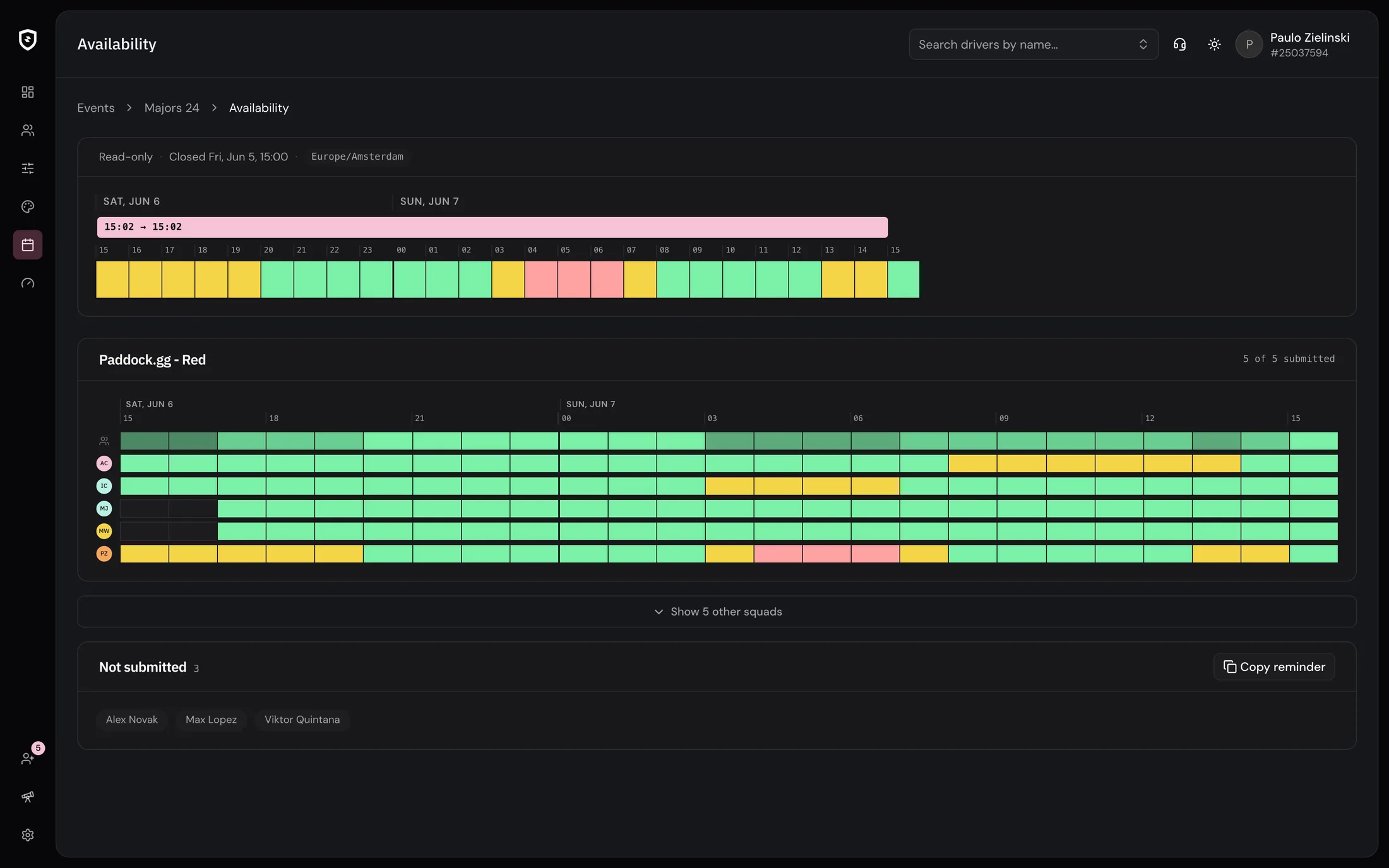
Built on real availability
Drivers mark when they can actually drive — once, in one place. The planner lays stints onto those windows, so the 3 am seat goes to someone who said yes to 3 am.
Live in the race, together
The plan is shared and updates in real time. When an unscheduled stop or a red flag rewrites the race, re-anchor the plan from that moment — every driver and spotter sees the new reality instantly.
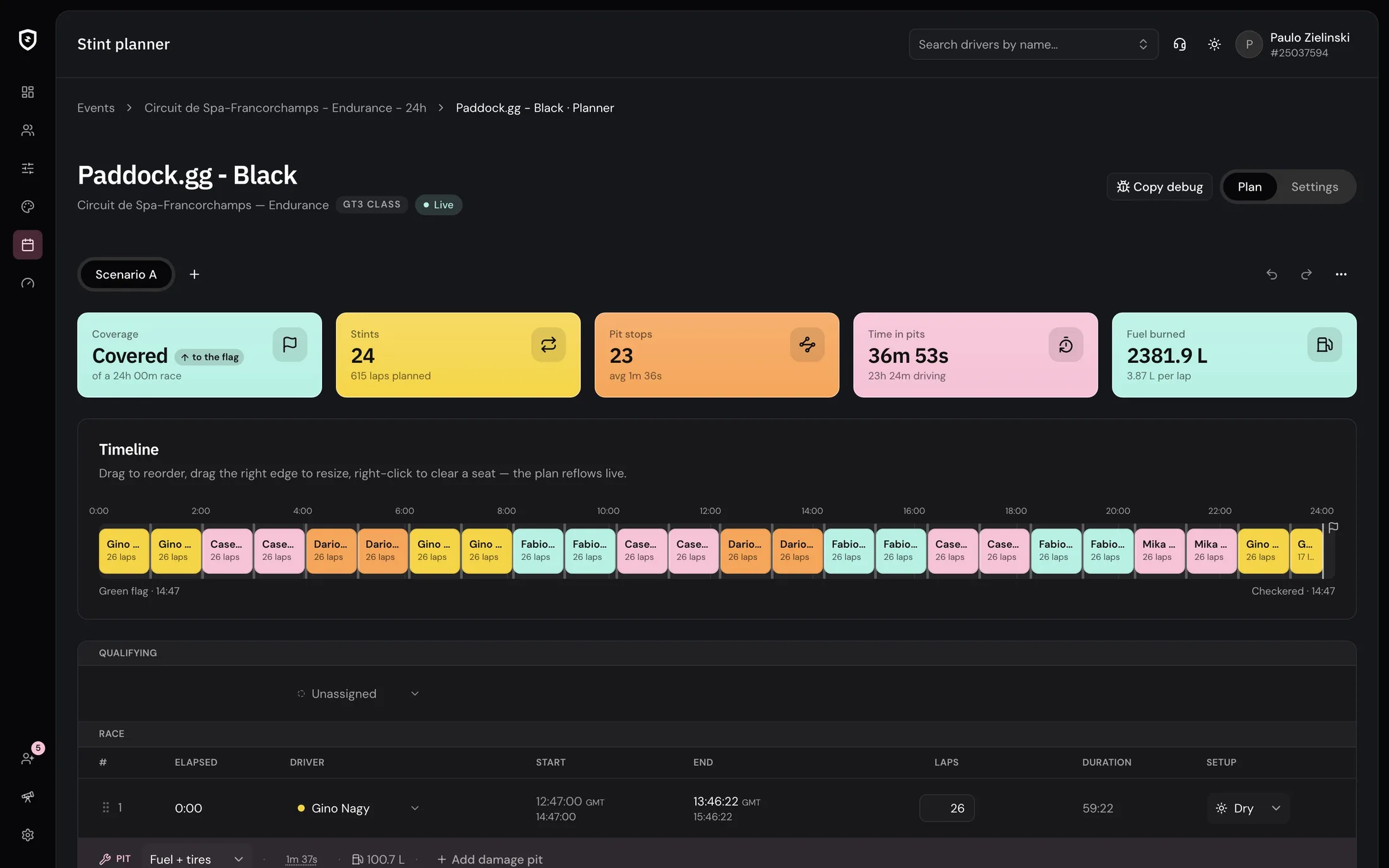
Every stint accounted for
Stint lengths, pit windows, driver swaps and rest between seats — laid out on one timeline the whole squad reads the same way. No more 'who's in after Marco?' on the radio.
The endurance problem
Planning an iRacing endurance race, without the spreadsheet
An iRacing endurance race lives or dies on the stint plan. A 6, 12 or 24-hour event means handing one car between three, six, sometimes a dozen drivers — each with a different pace, a different fuel window, and a different set of hours they can actually be at the wheel. Most teams still run that on a shared spreadsheet that is out of date the moment the race throws its first full-course yellow.
Paddock treats the stint plan as the thing it is: a live rotation, not a static document. You start from real driver availability — the windows each driver marked for themselves — and lay stints onto them. The overnight seat goes to someone who said yes to overnight, and nobody is volunteered for a stint they were never going to make.
From there it is one timeline the whole squad reads the same way: stint lengths, pit windows, driver swaps and the rest between seats. When the race rewrites itself — an early stop, a repair, a red flag — you re-anchor the plan from that moment instead of rebuilding it, and every driver and spotter watching sees the change instantly. That is the difference between managing an endurance race and chasing it.
Frequently asked questions
- Does the stint planner handle 24-hour races?
- Yes. Paddock is built for iRacing endurance racing at any length — a 90-minute sprint, a 6-hour, or a full 24 Hours of Le Mans or Daytona. You lay stints across the whole race on one timeline, so a dozen drivers and a two-car entry stay readable at a glance.
- How does Paddock know when each driver is available?
- Drivers mark their own availability once, in their local time zone, and the planner reads from it. Instead of guessing who can take the 3 am stint, you build the rotation on the hours drivers actually said yes to — no group chat roll-call the night before the race.
- What happens when the race does not go to plan?
- An unscheduled pit stop, a repair, or a red flag rewrites every stint after it. Rather than rebuilding the plan by hand, you re-anchor it from the moment things changed and the remaining stints, swaps and pit windows shift with it.
- Can every driver see the stint plan during the race?
- The plan is shared and updates in real time. When you re-anchor or edit a stint, every driver and spotter looking at it sees the new version immediately — nobody is racing off a screenshot that went stale two hours ago.
- Do I need a separate tool to track availability?
- No. Availability and the stint plan are the same feature in Paddock — the timeline you plan on is the availability drivers already filled in. That is the point: the plan is anchored to reality instead of to a spreadsheet that was optimistic on Tuesday.
Run the endurance race calmly
The plan holds because it was built on availability — and because it can change when the race does.